2026-07-22
How Tall Is David? Size, Weight, and Why Photos Lie
Michelangelo's David is 5.17 meters tall and weighs about 5,660 kg. Here is what those numbers feel like in the room, and why every photo you have seen flattens him.
 By Luca Moretti, Florence Accademia Gallery guide and skip-the-line specialist
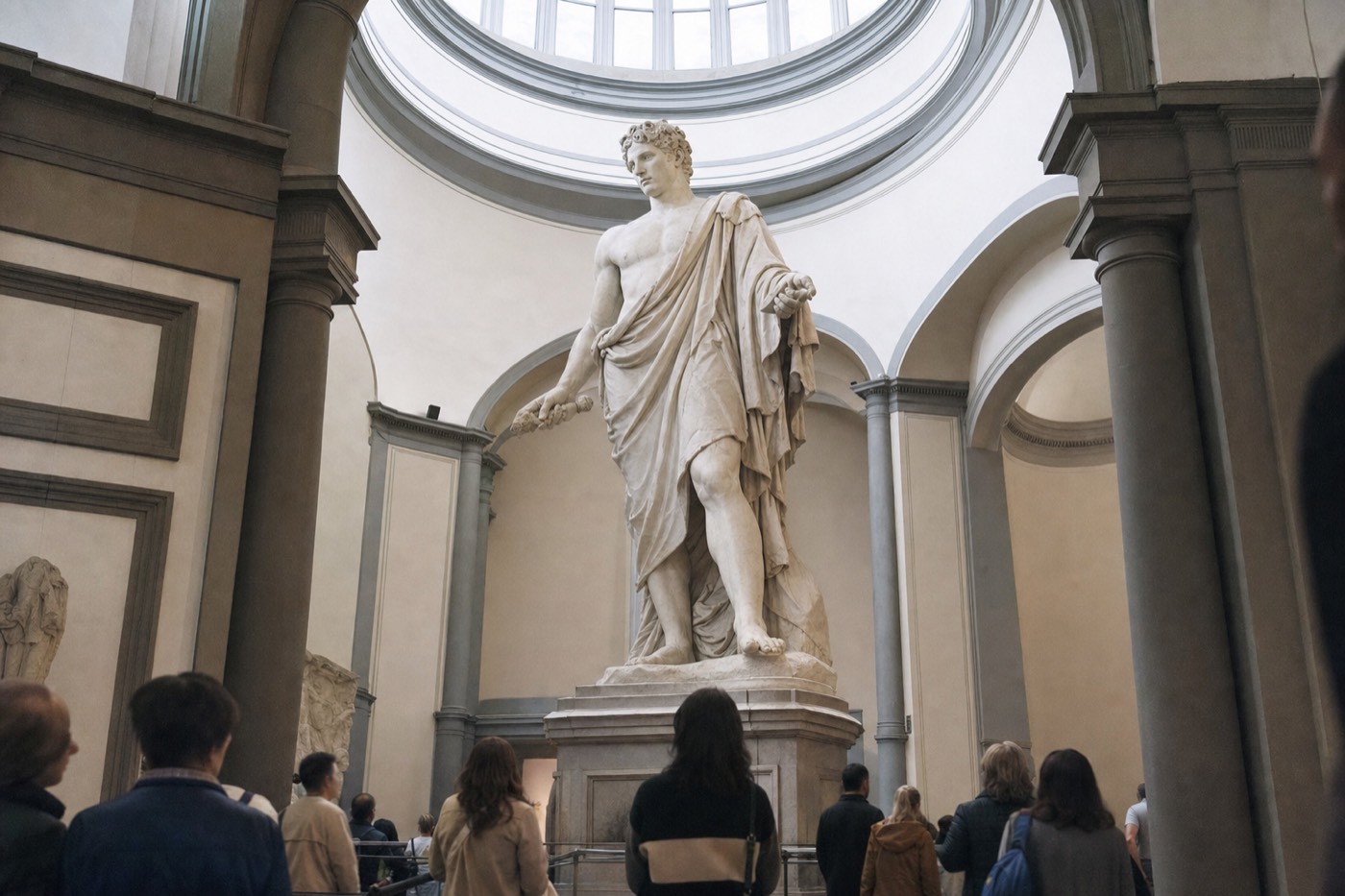
The first thing almost everyone gets wrong about David is how big he is. I ask my morning groups to guess before we turn the corner into the Tribuna, and the answers land around "life-size, maybe a bit taller". Then we walk in, and there is a small collective intake of breath, because the real figure is more than twice the height of a tall man and he stands on a pedestal on top of that. People reach for their phones on instinct. Ten minutes later, back out on Via Ricasoli, they look at what they captured and it never matches. The photo shows a nice statue. The room showed a giant.
How tall is the statue of David?
Michelangelo's David stands 5.17 meters tall, about 17 feet, and weighs roughly 5,660 kilograms with its base. He was carved from a single block of Carrara marble between 1501 and 1504. Set on the pedestal in the Accademia's Tribuna, his feet start above your head, so your eyeline meets his shins rather than his face.
Those are the figures the sources agree on. The statue's technical record gives the height as 517 centimeters and the marble as one continuous block, and Britannica's entry on the sculpture confirms the 1501 to 1504 carving window when Michelangelo was in his late twenties. What the numbers cannot tell you is the pedestal effect. In the Tribuna the base lifts the whole figure so that David towers a full two stories over the marble floor. You do not look at him. You look up at him, neck tilted, the way the citizens of 1504 looked up at him outside Palazzo Vecchio.
Here are the measurements that actually matter when you stand there:
| Measurement | Figure | In plain terms |
|---|---|---|
| Height of the figure | 5.17 m (17 ft) | Roughly three tall men, head to foot |
| Width | 199 cm | Wider than a doorway at the shoulders |
| Weight with base | ~5,660 kg | About four small cars |
| Marble | Single Carrara block | No joins, no repairs to the body |
| Carving period | 1501 to 1504 | Three years, one man, one stone |
The single-block detail is the one I lean on with guests. Every limb, the veins in the lowered right hand, the tension in the neck, all of it came out of one piece of stone with no room for a second try. Two sculptors had already given up on that exact block before Michelangelo touched it, a story I tell in full in my David guide. The figure at this height is the genuine article, not one of the outdoor copies people photograph by mistake, and I sort out where the real David actually stands if you have seen marble in a Florence square and wondered.
What can you compare David's size to?
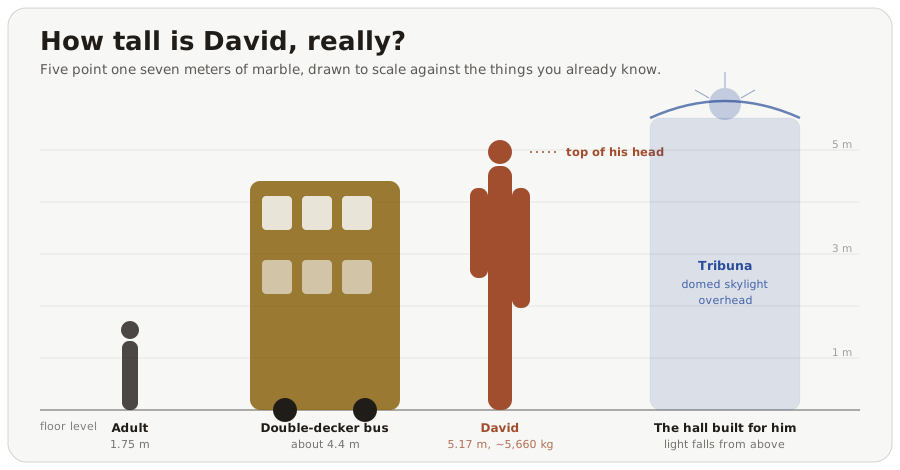
David is about as tall as three grown men standing on each other's shoulders, or a two-story building. At 5.17 meters he reaches the height of a London double-decker bus, and his marble weight of roughly 5,660 kilograms is close to four compact cars. The pedestal adds around another two meters on top.
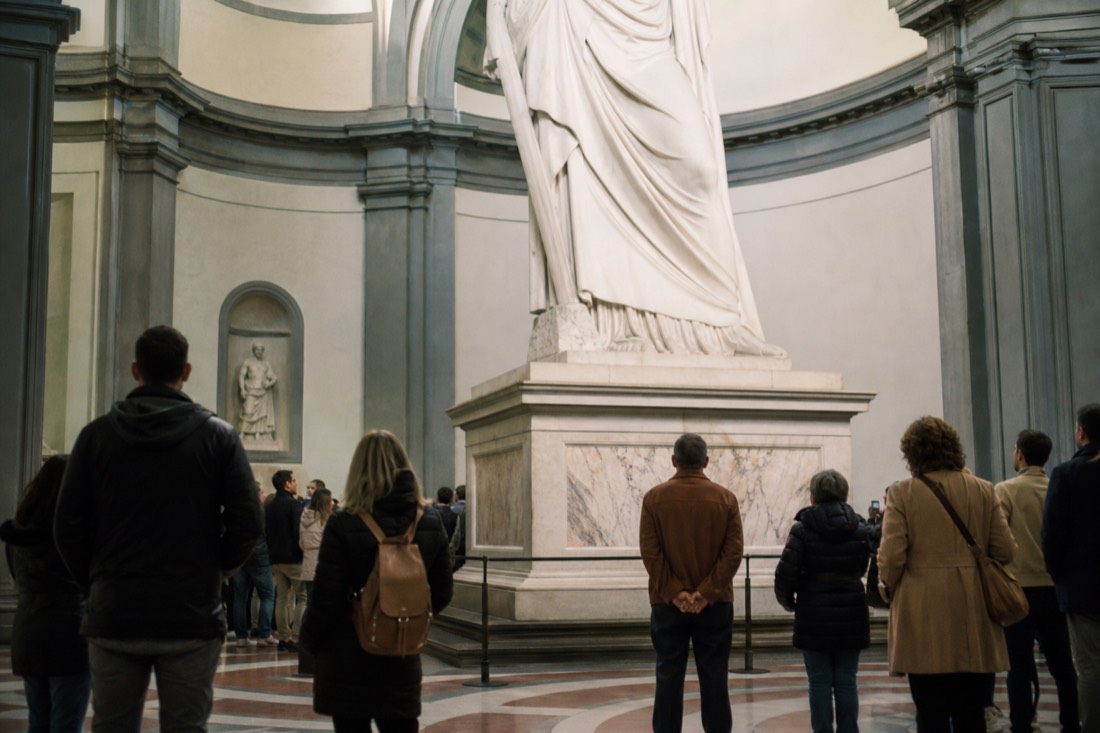
Comparisons help because 5.17 meters is an abstract number until you put a human next to it. The average adult male in Italy is around 1.75 meters. Stack three of them and you are still a touch short of David's crown. That is before the base, which raises his feet to roughly the height of a first-floor window. When people say the statue "felt overwhelming", this is the arithmetic underneath the feeling.
| You compared to David | Their height | David's height |
|---|---|---|
| Average adult | ~1.75 m | 5.17 m, about 3x taller |
| A basketball hoop | 3.05 m | 5.17 m, nearly double |
| A double-decker bus | ~4.4 m | 5.17 m, taller still |
| A two-story house floor-to-roof | ~5-6 m | 5.17 m, about the same |
There is a reason the scale surprises even people who read the numbers first. Michelangelo did not carve a giant human. He carved a human at giant size while keeping the proportions readable from far below, which is a different and harder problem. The head and the right hand are deliberately oversized, tuned for a viewer looking up from thirty feet away, not for a phone held at chest height.
Why does David look smaller in photos than in person?
Photos flatten David because the statue was designed to be seen from below, and a camera cancels that angle. His head, hands, and upper body are enlarged so they read correctly to an upward-looking eye. Shoot him straight on and those proportions look merely large instead of monumental, and the two-story pedestal drops out of frame entirely.
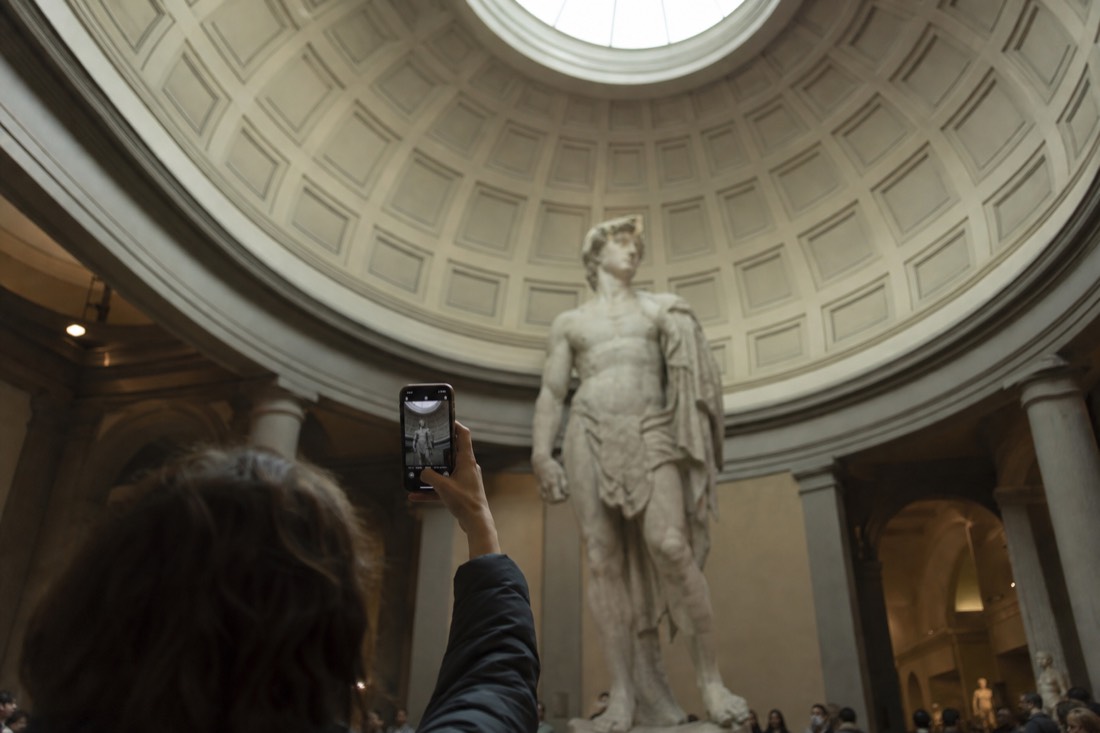
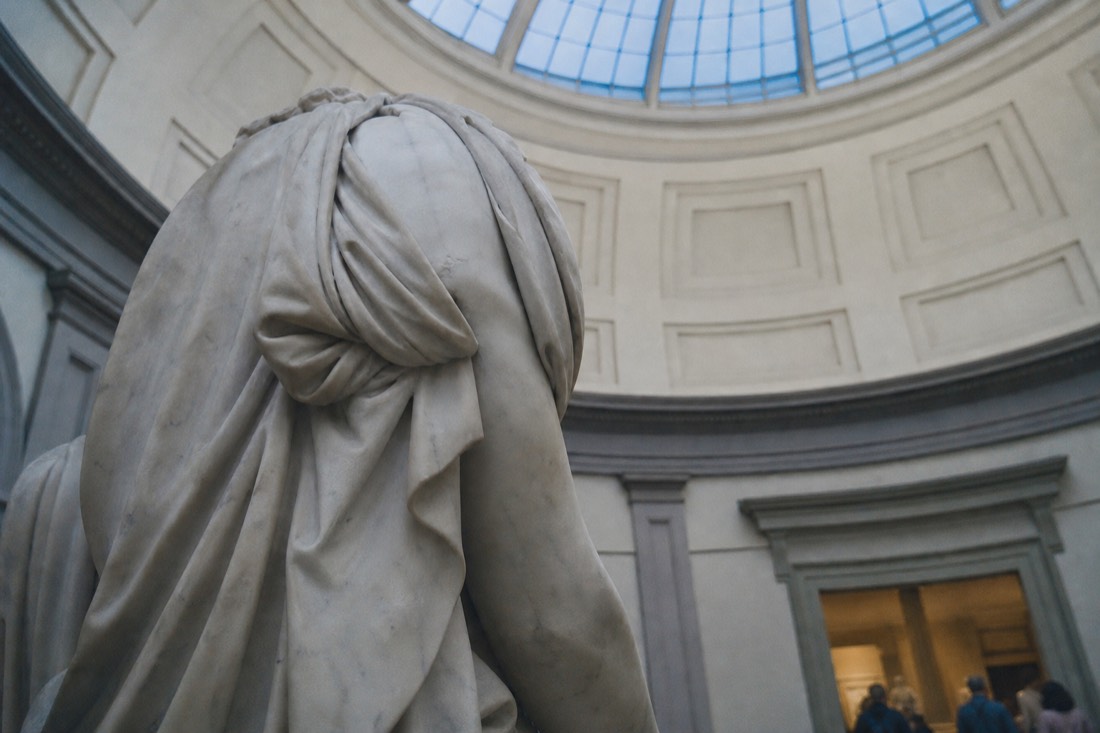
This is my favorite thing to explain in the room, because it turns a "bad photo" into a lesson in how Michelangelo thought. He knew David would sit high on the roofline of Florence Cathedral, the original plan, and later at height outside the town hall. So he compensated. The right hand, the one hanging by David's thigh, is famously too big. The head is slightly too large for the body. From below, on a pedestal, your eye reads those parts as correct and the whole figure snaps into perfect proportion. Bring the camera to David's own level and the correction becomes a distortion.
The other half of the problem is simple framing. To fit all 5.17 meters plus the base into a photo, you back up, tilt up, and the statue shrinks against the huge Tribuna and its skylight. The people around the base vanish, and with them goes your only sense of scale.
| What the room gives you | What the photo loses |
|---|---|
| Upward viewing angle | The proportions read as flat |
| The two-story pedestal | Cropped out to fit the figure |
| People at the base for scale | Reduced to specks or cut off |
| The skylight glow overhead | Blown out or darkened by the camera |
| The slow approach down the gallery | No sense of arrival |
If you want the statue to look the way it feels, stand close, shoot upward from near the base, and let a person or two sit in the bottom of the frame. You still will not fully capture him. Nobody does. That gap between the picture and the presence is exactly why seeing him in person is worth the trip, and it is the same reason the finished surface matters so much once you know what David originally looked like when he was first unveiled.
How do you stand in front of David yourself?
Reserve a timed entry slot before you travel. The walk-up ticket is 20 EUR when slots remain, an official reserved ticket is 24 EUR with the booking fee, and a timed skip-the-line ticket has a provider-set price. Any reserved route lets you skip the unreserved line, which commonly runs 1 to 2 hours in season, and clear security in roughly 10 to 20 minutes.
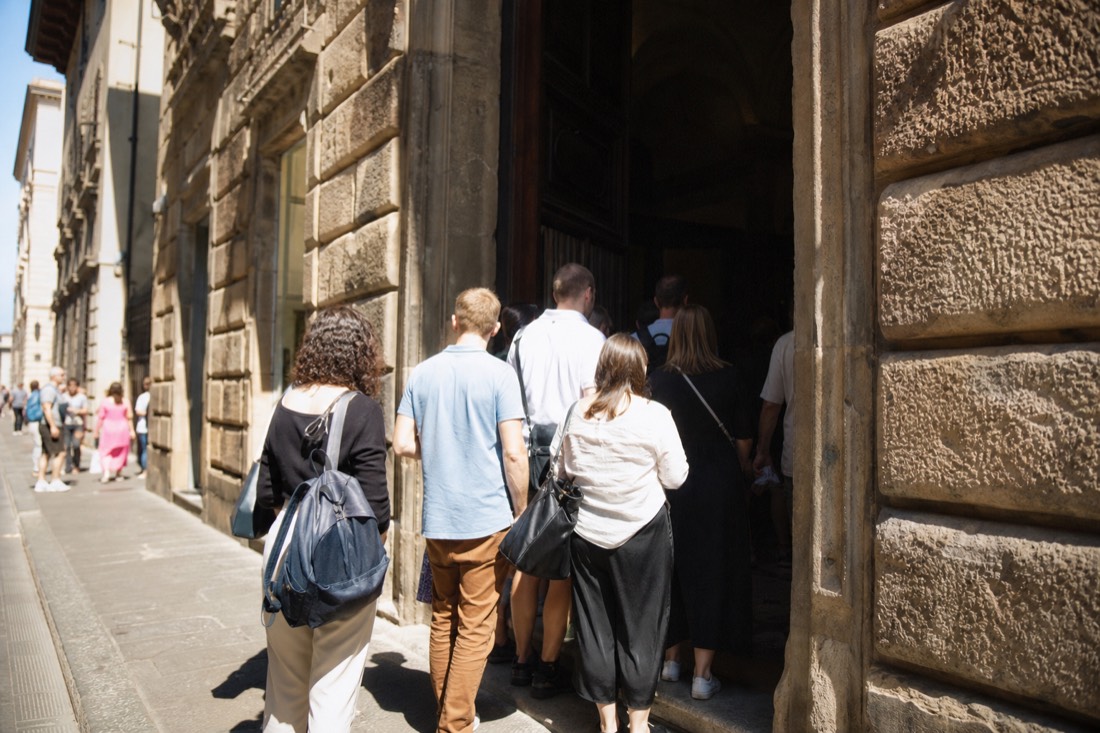
The scale is the whole point of coming, and the scale only lands from the right distance in a quiet room. That is the case for arriving early and reserved rather than late and lining up. Early slots may suit your plan, but no slot guarantees a quiet room. The museum lists its hours, prices and free days on the official visiting page, and on free-admission days there is no booking at all, just a first come, first served line that can swallow a morning.
| Route in | What you pay | Typical wait |
|---|---|---|
| Walk up without a reservation | 20 EUR | 1-2 hours commonly reported in season |
| Official reserved slot (B-Ticket) | 24 EUR with fee | Security only, usually 10-20 min |
| Timed skip-the-line ticket with host | Current provider price | Ticket pickup plus security, 10-20 min |
| Free day, first Sundays and holidays | 0 EUR | Open-ended line, no reservations exist |
If you are weighing the official site against a reseller, I lay out the trade-offs in official vs third-party tickets.
Come with the numbers in your head if you like, 5.17 meters, 5,660 kilograms, one block of Carrara stone. They will still not prepare you. The moment you turn into the Tribuna and your neck tips back is the moment the statistics stop mattering, and I get to watch that happen several mornings a week. Bring a friend to stand at the base. You will want the scale in at least one photo, even knowing it can never hold the whole of him.
Your Next Step
Check Your Florence Date
Accademia With An English Guide
Have your travel date in mind? See David with an English-speaking guide, then stay inside to explore independently. Check the start and meeting details before arranging your next stop.
65 minutes; admission and headsets included. Meet at Via Ricasoli 39, 15 minutes early. No hotel pickup, meals or luggage storage.
Initial editorial suggestion. Confirm the option, party requirements and final total before paying.
Scheduled departures load automatically. Final availability and price are confirmed on Viator.
A scheduled start is not a confirmed place. Your date is a planning aid; select it again on Viator.
No verified option fits those choices. Adjust the controls or reset to the general suggestions.
Compare Options And Fit This To Your Visit
Accademia With An English Guide: See David with an English-speaking guide, then stay inside to explore independently. 65 minutes; admission and headsets included. Meet at Via Ricasoli 39, 15 minutes early. No hotel pickup, meals or luggage storage.
Accademia Timed Entry: Explore David, the Prisoners and the other permanent rooms at your own pace. 60 minutes suggested; allow extra time for security. Meet at Via Ricasoli 45 blue, 15 minutes early; bring matching ID for every visitor. No live guide or luggage storage.
Accademia Entry And Audio Options: Choose an independent visit with a phone audio guide, or select a licensed guided option. About 1 hour. Permanent exhibitions included. Audio and guided inclusions depend on the option selected. Bring ID, a charged phone and headphones; arrive 10–15 minutes early at the option’s meeting point. Large bags prohibited.
Private Accademia Art Tour: Discuss David and the unfinished sculptures with your own art historian guide. 2 hours; admission included. Selected central hotels offer walking pickup, not a car transfer. Confirm your exact hotel or meeting point with the operator.
Affiliate links may earn us a commission at no extra cost to you. Booking is completed with the provider.