2026-07-22
What David Originally Looked Like (Gilding, a Skirt of Leaves, and 350 Years of Weather)
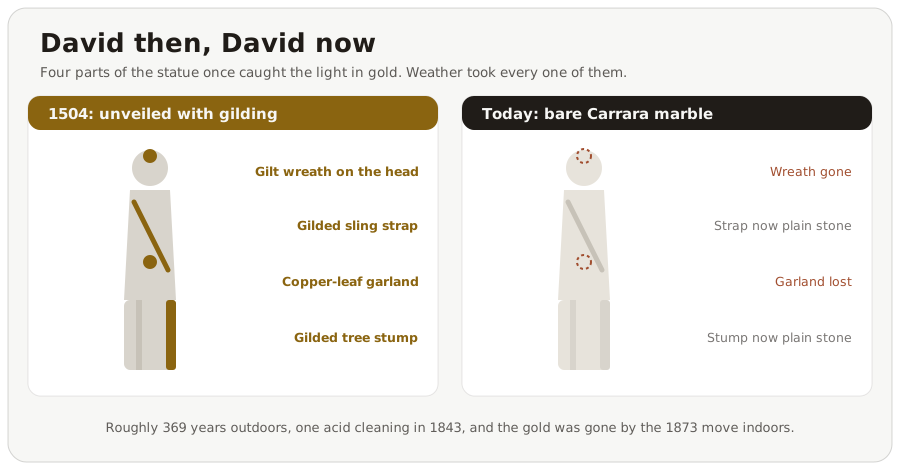
The David you see today is bare white marble. The one Florence unveiled in 1504 wore gold on the sling, the stump, and a wreath, plus a garland of copper leaves. Here is what changed over three centuries outdoors.
 By Luca Moretti, Florence Accademia Gallery guide and skip-the-line specialist
The David you photograph today is a pale, near-white column of Carrara marble, and that plainness feels so permanent that most guests assume it is original. It is not. The statue Florence cheered in 1504 caught the sun differently, because parts of it were gilded. Gold on the sling strap. Gold on the tree stump at his leg. A gilt wreath in the hair, and soon after, a garland of copper leaves at the groin. Then came 369 years standing outdoors, a century of soot, one disastrous cleaning, and finally the move indoors. What survives is the sculpture stripped back to stone. Here is what time took off him, detail by documented detail.
What did the David originally look like when it was unveiled?
When David was unveiled in 1504, several parts were gilded to catch the light: the sling strap across his shoulder, the tree stump supporting his right leg, and a victory wreath or garland on his head. The gold read clearly against the marble in open daylight. Weather stripped every gilded surface long before the statue moved indoors.
This surprises almost everyone, because we have inherited a taste for bare white marble that the Renaissance did not fully share. Gilding on select details was a way to guide the eye, and on a five-meter figure seen from below in a bright square, small touches of gold on the sling and stump would have flickered in a way flat stone cannot. The statue's documented history records the gilding of the stump and sling strap and the garland on the head.
None of it was Michelangelo painting his figure like a toy. Gilding was restrained and structural to the composition, marking the weapon and the support. Seen fresh in 1504, David would have looked less like a museum object and more like a civic monument dressed for a festival. For the fuller picture of who he is and why Florence built him, my complete David guide lays out the commission and the meaning.
| Feature | In 1504 | Today |
|---|---|---|
| Sling strap | Gilded, catching light | Plain marble |
| Tree stump at the leg | Gilded | Plain marble |
| Wreath or garland on the head | Gilded | Gone entirely |
| Groin | Bare | A copper-leaf garland was added, later lost |
Was there really a skirt of leaves on the David?
Yes, though "skirt" oversells it. Soon after installation, Florentine authorities added a garland of gilded copper leaves around David's groin, a modest civic cover-up rather than a fashion choice. It was a real, documented fixture on the outdoor statue, and like the gilding, it did not survive the centuries of weather.
I always enjoy telling this one, because it undercuts two modern assumptions at once: that the Renaissance was entirely relaxed about nudity, and that David has always looked exactly as he does now. Neither is true. The copper leaves were a compromise, enough to satisfy propriety without touching the marble, and the sculpture's record notes the vine of copper leaves added around the groin along with the gilded stump and sling.
This makes David the earliest chapter in a long habit of covering him up, one that runs all the way to a Victorian plaster fig leaf and a 2023 school controversy. I trace that whole thread in David's censorship stories. The leaves matter here for a different reason: they are evidence that the pristine white figure in the tribune is an edited version of the original. Michelangelo carved a nude. Florence dressed it slightly. Time undressed it again.
| Added detail | Material | Purpose | Fate |
|---|---|---|---|
| Groin garland | Gilded copper leaves | Modesty in a public square | Lost to weathering |
| Sling and stump gilding | Gold leaf | Catch light, mark key parts | Lost to weathering |
How long did the David stand outdoors?
Roughly 369 years. David was installed in the open air of Piazza della Signoria in 1504 and stayed there until 1873, when Florence moved him indoors to the Accademia to protect the marble. That is nearly three and a half centuries of sun, rain, frost, and city soot working on an exposed statue.
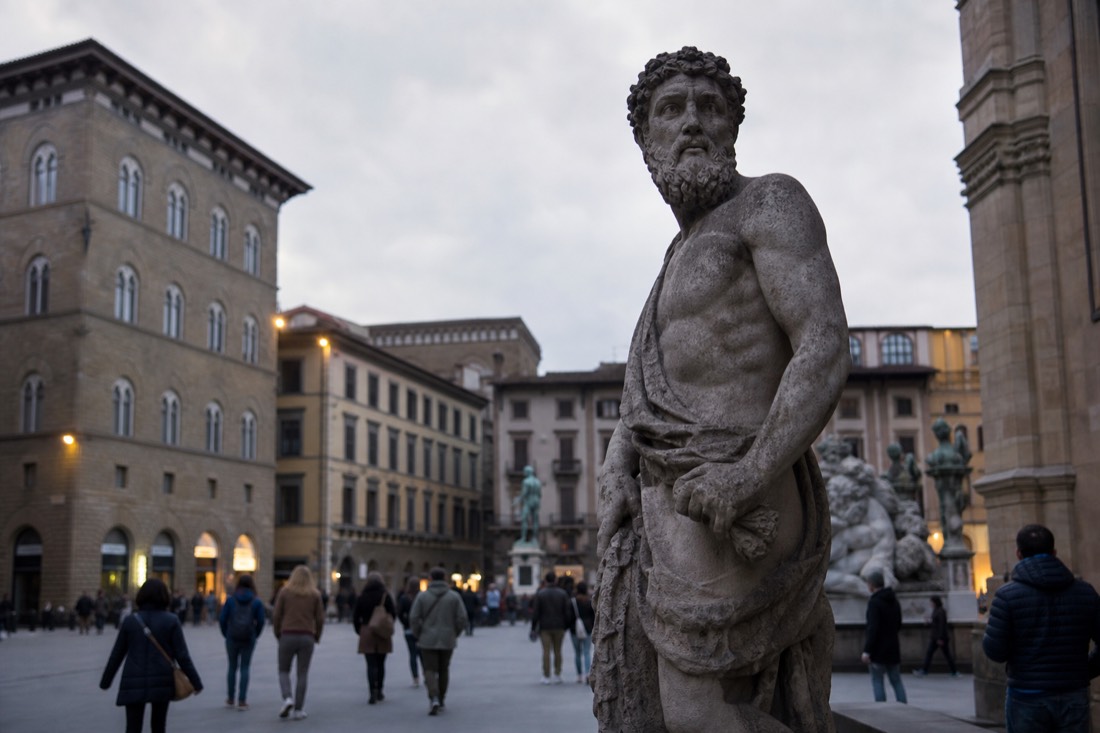
Think about what that span really means. David faced the weather of the Little Ice Age, generations of pigeons, wood smoke from a whole city heating itself, and the general grime of standing at the political heart of Florence. Marble is tougher than it looks, but it is not inert. The surface slowly lost its gilding, gathered a crust, and developed the stress that would later show up as fine cracks in the ankles and stump.
By the mid-1800s the exposure was clearly a problem, and the decision to move him was a rescue, not a promotion. The gallery built for him is the one you visit now. If you are curious how the scale reads once he is finally indoors and close, I cover the true dimensions in how tall David is, because the numbers land differently when you know he spent centuries towering over an open square instead.
| Year | What happened outdoors |
|---|---|
| 1504 | Unveiled in Piazza della Signoria, gilded and garlanded |
| soon after | Copper-leaf garland added at the groin |
| 1843 | Cleaned with acid, damaging the surface |
| 1873 | Moved indoors to the Accademia for protection |
What damage did the centuries outdoors do?
The weather stripped the gilding, and human care sometimes made things worse. An 1843 cleaning used acid that harmed the surface. After the 1873 move and a 1991 hammer attack, a 2003 to 2004 conservation for the statue's 500th anniversary sparked a public dispute over wet versus dry cleaning methods before a gentle approach was chosen.
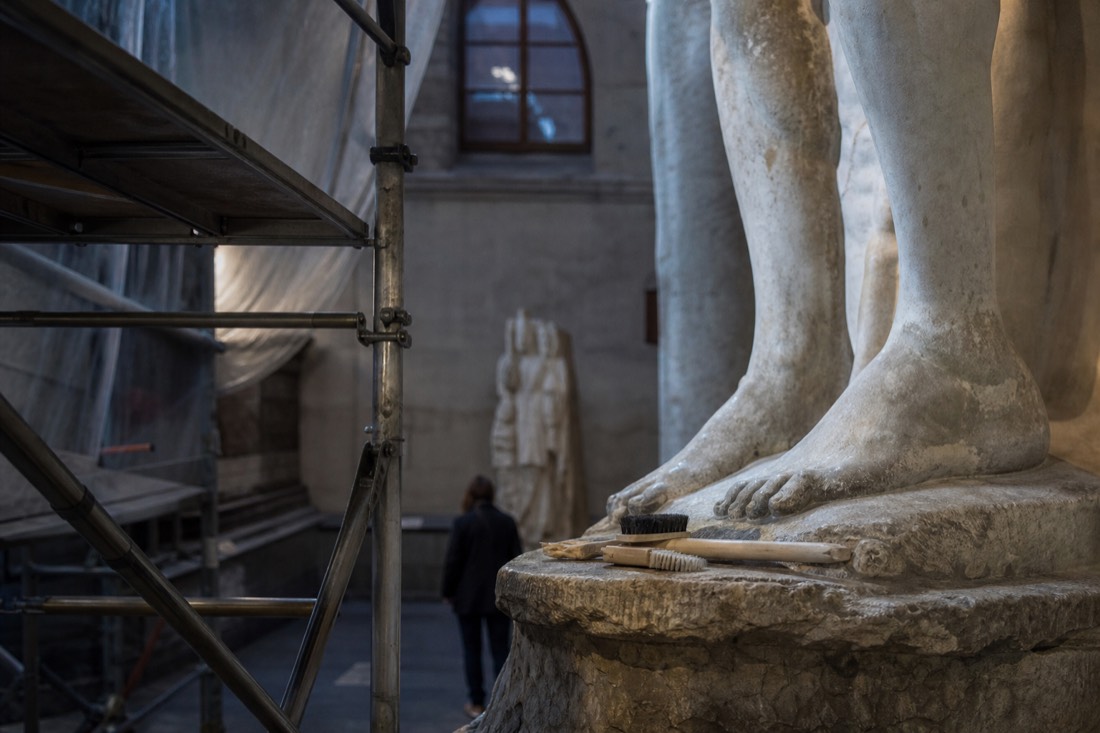
The 1843 episode is the cautionary tale. In an effort to brighten the statue, restorers used hydrochloric acid, which ate into the marble's outer skin and removed traces of the original surface, damage the sculpture's conservation history still records. It is a reminder that "cleaning" a masterpiece is never neutral.
By the turn of this century the stakes were understood. When the Accademia planned a cleaning for the 2004 anniversary, experts argued sharply about whether to use a dry method or mild moisture, one conservator stepping aside over the disagreement before a careful, minimally wet approach went ahead. Today David is dusted regularly and monitored for the fine fractures in his lower legs, using instruments rather than acid. The contrast with 1843 is the whole story of how conservation grew up around this one figure.
How do you see the real, un-gilded David today?
Book a timed entry slot at the Accademia before you travel. The unreserved walk-up line commonly runs 1 to 2 hours in season, while a timed ticket clears security in roughly 10 to 20 minutes. Prices go from 20 EUR at the door to the current provider total for a timed skip-the-line ticket.
Standing in front of the bare marble, knowing it once wore gold, changes how you look at it. The museum lists its hours, prices and free days on the official visiting page, and the door price is 20 EUR when slots remain. In spring and summer the walk-up line on Via Ricasoli is long and the early slots go weeks ahead, with the 8:15 opening filling first.
Pickup is a paper ticket two minutes from the door, luggage storage is included, and cancellation is free up to 24 hours before. Whether to book officially or through a reseller depends on how much flexibility you want, which I compare in official vs third-party tickets.
So the honest answer to what David originally looked like is: warmer, brighter, and slightly dressed. Gold on the sling and stump, a wreath in the hair, copper leaves at the groin, all of it read against Carrara white in the open light of a Florentine square. Three and a half centuries of weather, one acid bath, and a careful modern conservation later, we are left with the marble alone. I have come to love it that way, stripped to Michelangelo's stone. But it helps to know the giant once glinted, and that the plainness we admire is what remains after time did its editing.
Your Next Step
Check Your Florence Date
Accademia With An English Guide
Have your travel date in mind? See David with an English-speaking guide, then stay inside to explore independently. Check the start and meeting details before arranging your next stop.
65 minutes; admission and headsets included. Meet at Via Ricasoli 39, 15 minutes early. No hotel pickup, meals or luggage storage.
Initial editorial suggestion. Confirm the option, party requirements and final total before paying.
Scheduled departures load automatically. Final availability and price are confirmed on Viator.
A scheduled start is not a confirmed place. Your date is a planning aid; select it again on Viator.
No verified option fits those choices. Adjust the controls or reset to the general suggestions.
Compare Options And Fit This To Your Visit
Accademia With An English Guide: See David with an English-speaking guide, then stay inside to explore independently. 65 minutes; admission and headsets included. Meet at Via Ricasoli 39, 15 minutes early. No hotel pickup, meals or luggage storage.
Accademia Timed Entry: Explore David, the Prisoners and the other permanent rooms at your own pace. 60 minutes suggested; allow extra time for security. Meet at Via Ricasoli 45 blue, 15 minutes early; bring matching ID for every visitor. No live guide or luggage storage.
Accademia Entry And Audio Options: Choose an independent visit with a phone audio guide, or select a licensed guided option. About 1 hour. Permanent exhibitions included. Audio and guided inclusions depend on the option selected. Bring ID, a charged phone and headphones; arrive 10–15 minutes early at the option’s meeting point. Large bags prohibited.
Private Accademia Art Tour: Discuss David and the unfinished sculptures with your own art historian guide. 2 hours; admission included. Selected central hotels offer walking pickup, not a car transfer. Confirm your exact hotel or meeting point with the operator.
Affiliate links may earn us a commission at no extra cost to you. Booking is completed with the provider.