2026-07-22
Michelangelo's David vs Donatello's: Two Statues, One Conversation
Donatello's bronze David and Michelangelo's marble David sit across town from each other in Florence. What separates them, and how to see both in one day.
 By Luca Moretti, Florence Accademia Gallery guide and skip-the-line specialist
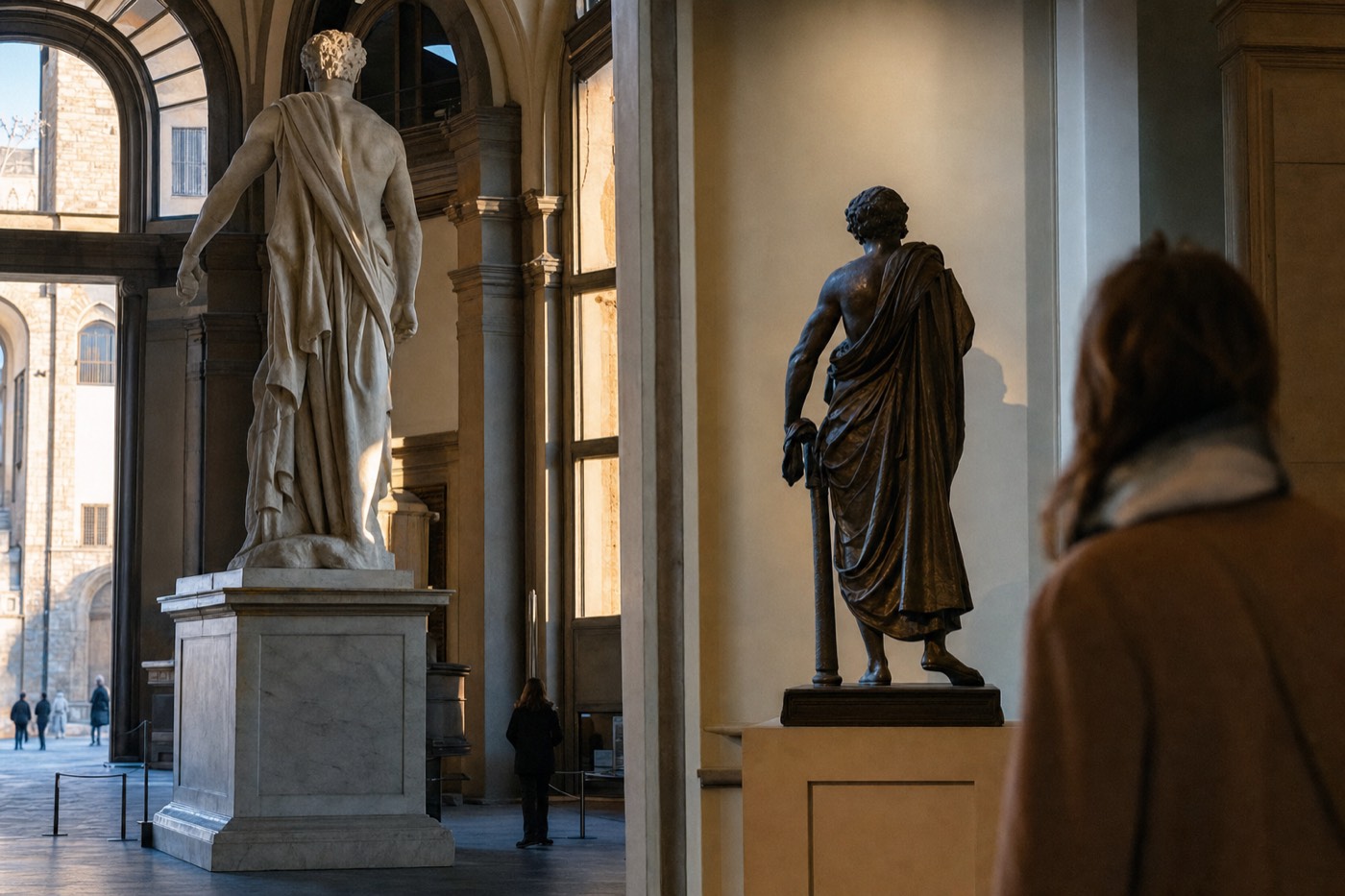
There are two Davids in Florence that matter, and they are having an argument across the city. One is marble, five meters of it, a young man bracing for a fight he has not yet won. The other is bronze, barely taller than a child, a soft boy standing on the severed head of the giant he already killed. Most visitors meet only the first. I think you should meet both, in that order, and let them talk to each other.
What is the difference between Donatello's and Michelangelo's David?
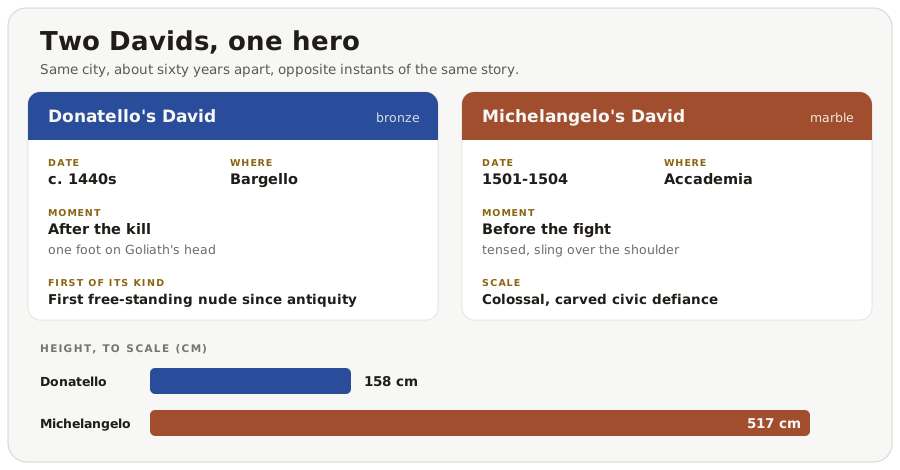
Donatello's David is a small bronze from the 1440s, about 158 cm tall, standing victorious over Goliath's severed head in the Bargello. Michelangelo's David is a colossal marble from 1501 to 1504, about 517 cm tall, tensed before the fight, in the Accademia. Roughly sixty years and two different worlds separate them.
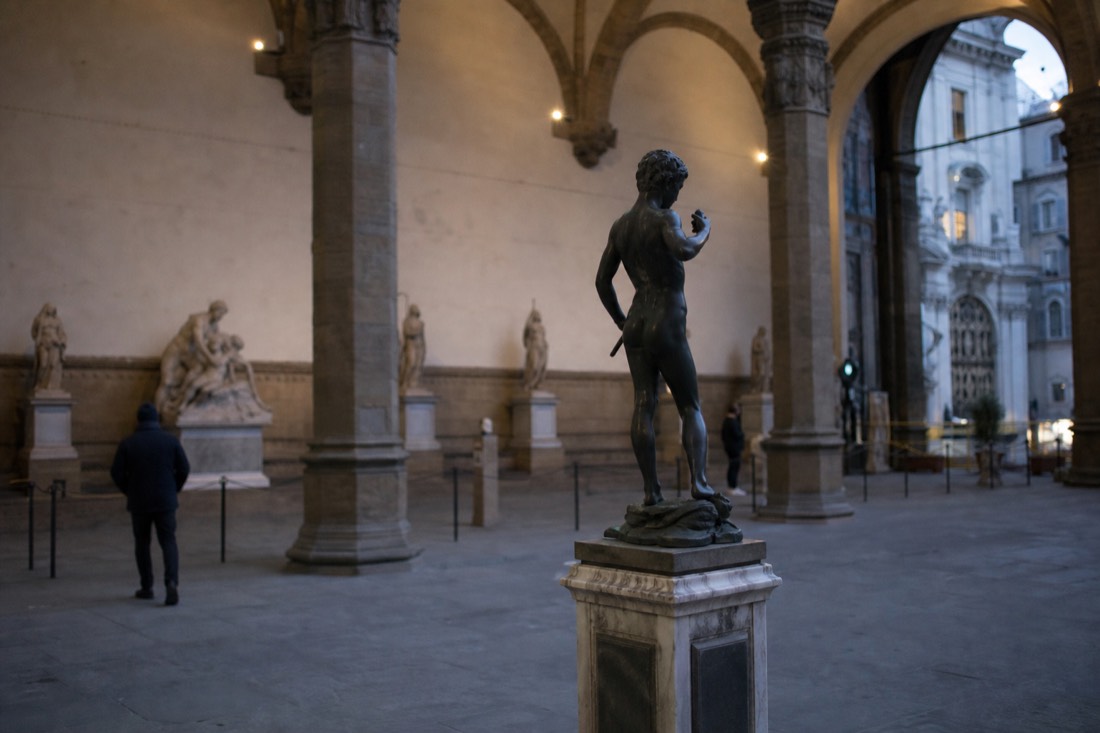
The contrast starts with the body in your field of view. Donatello's bronze you take in at a glance, intimate and strange, a nude boy in a shepherd's hat. Michelangelo's marble you cannot take in at all without stepping back and tilting your head, the way the Tribune forces you to. The dates and the raw facts are set out on Wikipedia's page for Michelangelo's David, and the difference in scale alone reframes what each sculptor was trying to do.
| Donatello's David | Michelangelo's David | |
|---|---|---|
| Material | Bronze | Carrara marble |
| Height | About 158 cm | About 517 cm |
| Date | c. 1440s | 1501-1504 |
| Where | Bargello | Accademia |
| Moment shown | After the kill | Before the fight |
Two statues, one hero, opposite instants. That is the conversation, and once you see it you cannot unsee it. The bronze is a victory lap. The marble is the held breath before anything happens. Everything else, the size, the medium, the mood, flows from that single choice of moment.
What moment does each David capture?
Donatello shows the aftermath: David relaxed, almost dreamy, one foot resting on Goliath's head, the battle already won. Michelangelo shows the anticipation: David alert and coiled, sling over his shoulder, eyes fixed toward the enemy, the stone not yet thrown. One is triumph, the other is nerve.
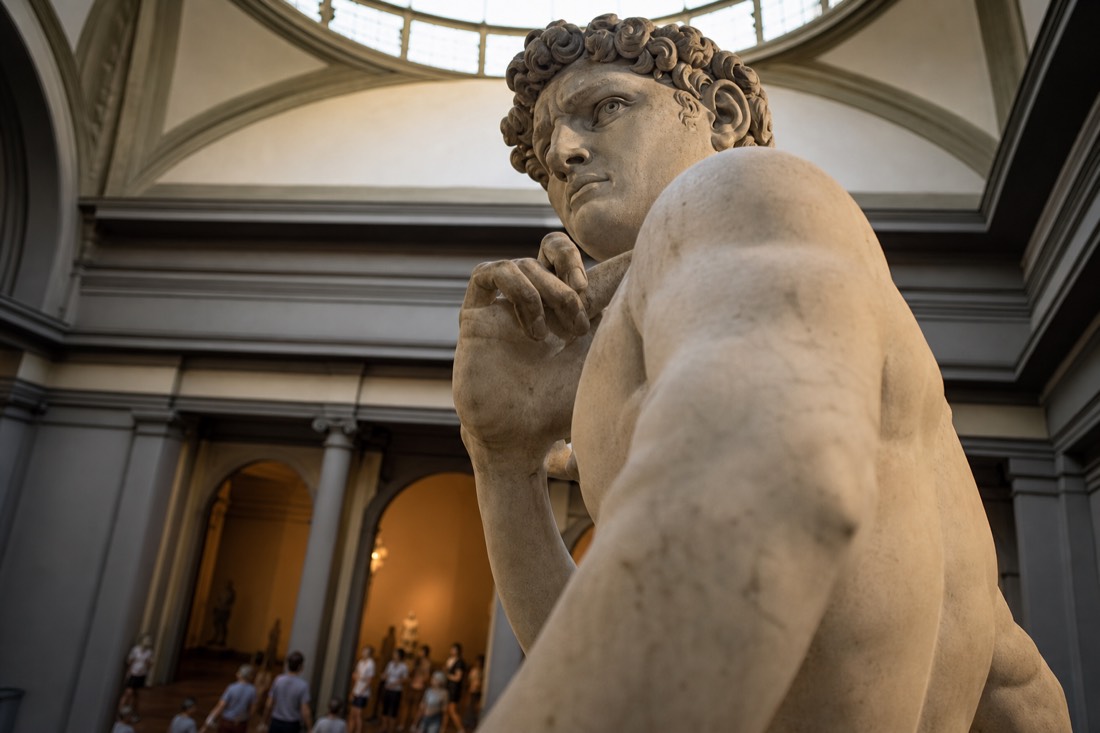
This is the part that changes how people look. Donatello's boy has come through it, and his body knows it, the weight loose, the pose almost coy. Stand him next to Goliath's head and the story is finished. Michelangelo refused that ending. He caught David in the second before courage becomes action, the brow drawn, the neck turned, the great right hand loose around a stone. Britannica's entry on the sculpture describes that psychological tension as the heart of the marble's power, and standing under it you feel exactly why.
The option I point guests to runs at a variable provider price, Current reviews are shown on the provider page, and includes pickup two minutes from the door with free cancellation up to 24 hours.
| The instant each sculptor chose | Reading |
|---|---|
| Donatello, bronze | Victory, calm, the giant already dead |
| Michelangelo, marble | Tension, resolve, the fight still to come |
| Shared subject | The same biblical David, opposite seconds |
For why the marble version, in particular, went on to eclipse every other David ever made, I keep a separate piece on why David is so famous. But the honest point is that Donatello got there first, and getting there first, in this story, was its own kind of revolution.
Why was Donatello's David so revolutionary?
Because it was the first free-standing nude statue since antiquity. For roughly a thousand years after Rome, European sculpture avoided the unsupported nude. Donatello's bronze, cast in the 1440s, brought it back, a life-size naked figure standing on its own, and that made it one of the boldest objects of the entire Renaissance.
It is hard, now, to feel how daring that was. We are surrounded by nudes in art. In the 1440s a free-standing naked bronze, life-size, with nothing to lean on and nothing to excuse it, was almost scandalous, and it announced that Florence intended to pick up where the ancient world had stopped.
The material choice carried its own boldness. Casting a life-size figure in bronze was slow, expensive and technically demanding, the kind of commission only serious money could underwrite, and the Medici money was behind this one. The statue stood in a private courtyard, seen by the family and its guests rather than the public square, which is part of why its daring was quieter than the marble's would be. It whispered where Michelangelo's David, sixty years on, would shout. Michelangelo, sixty years later, took that permission and made it enormous. Without Donatello's quiet bronze there is no colossal marble, because someone had to make the nude respectable again first.
| The roughly sixty-year gap | What it says about Florence |
|---|---|
| Donatello, 1440s | A republic testing how far it could revive antiquity |
| Between the two | Wealth, humanism and confidence compounding |
| Michelangelo, 1501-04 | A city ready to carve its ideals five meters tall |
That thread, one city returning to the same hero across two generations, is part of a bigger family of Davids scattered around town, which I map in the three Davids of Florence. Seeing them in sequence is the best art-history lesson the city gives for free, and two of the great ones sit close enough to pair in a single day.
Can you see both Davids in one day in Florence?
Yes, easily. The Bargello, home of Donatello's bronze, is a short walk from the Accademia, and since 15 March 2026 the two museums share one ticketing group. A 48-hour combined ticket covering both costs 26 euros, so you can do marble in the morning and bronze in the afternoon.
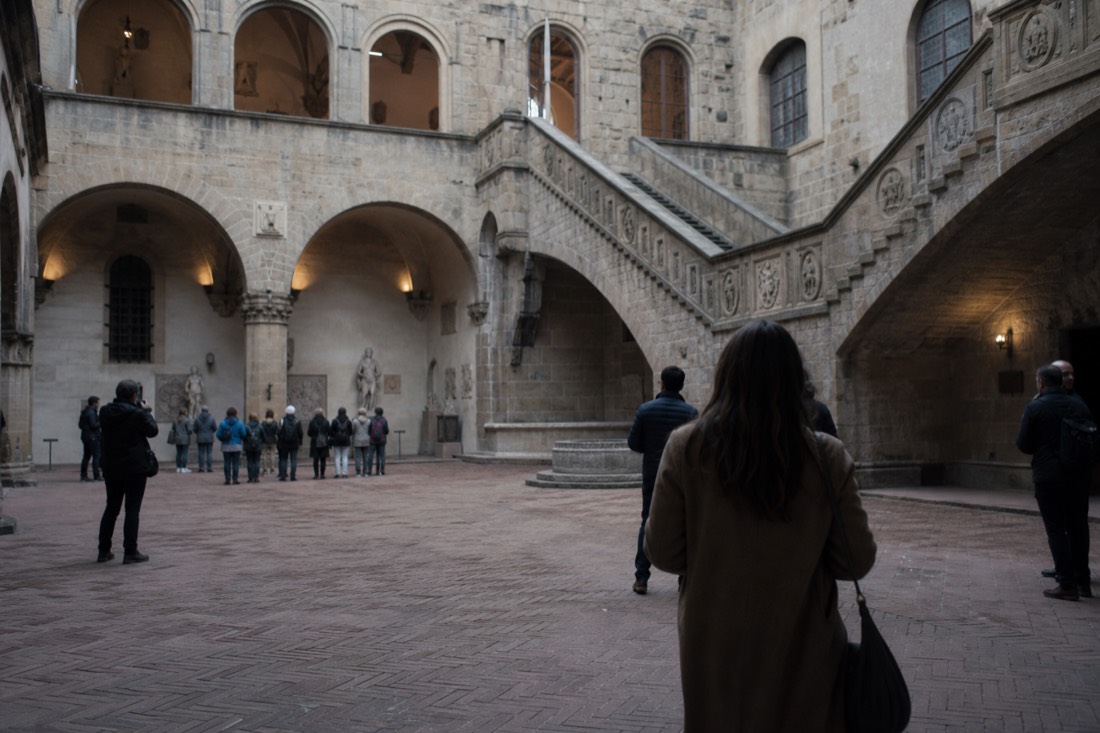
The geography is kind. Both museums keep the same core hours, Tuesday to Sunday, 8:15 to 18:50, and both close on Mondays, so plan around that shared day off. My routine is Accademia at opening, when David has the room almost to himself, then a slow walk south through the center to the Bargello after lunch, when the bronze courtyards are cool and quiet. The combined ticket, detailed on the official visit page, makes the pairing cheaper than two singles.
| Ticket option | Price | Valid |
|---|---|---|
| Accademia, full | 20 EUR (+4 EUR fee) | Timed entry |
| Bargello, full | 12 EUR | Single visit |
| Accademia + Bargello combo | 26 EUR | 48 hours |
| All six museums combo | 38 EUR | 72 hours |
For the deep dive on the marble itself, my full guide to Michelangelo's David covers the pose, the hand and the stare in detail, and if you are choosing between the Accademia and the city's other giant, the Uffizi versus Accademia comparison lays out the trade-off.
What does the sixty-year gap say about Florence?
It shows a city compounding its own confidence. In the 1440s Florence dared to revive the free-standing nude in bronze. By 1501 it dared to carve civic defiance five meters tall in marble. The same republic, richer and bolder, kept raising the stakes on the same young hero.
David was never a neutral subject in Florence. He was the underdog who beat the giant, and a republic surrounded by bigger powers saw itself in him. Donatello's bronze made that identification elegant and private, a treasure for a Medici courtyard. Michelangelo's marble made it public and enormous, a warning planted outside the seat of government. The distance between the two statues is the distance between a city that hopes and a city that dares, measured in about sixty years and several tons of stone.
That is why I send people to both. One statue tells you what Florence wanted to be. The other tells you it decided it already was.
Do the pairing if you can. Two Davids, one afternoon of walking between them, and you will understand more about Florence than any single masterpiece can teach you on its own.
Your Next Step
Check Your Florence Date
Accademia Timed Entry
Have your travel date in mind? Explore David, the Prisoners and the other permanent rooms at your own pace. Check the start and meeting details before arranging your next stop.
60 minutes suggested; allow extra time for security. Meet at Via Ricasoli 45 blue, 15 minutes early; bring matching ID for every visitor. No live guide or luggage storage.
Initial editorial suggestion. Confirm the option, party requirements and final total before paying.
Scheduled departures load automatically. Final availability and price are confirmed on Viator.
A scheduled start is not a confirmed place. Your date is a planning aid; select it again on Viator.
No verified option fits those choices. Adjust the controls or reset to the general suggestions.
Compare Options And Fit This To Your Visit
Accademia Timed Entry: Explore David, the Prisoners and the other permanent rooms at your own pace. 60 minutes suggested; allow extra time for security. Meet at Via Ricasoli 45 blue, 15 minutes early; bring matching ID for every visitor. No live guide or luggage storage.
Bargello Museum Entry: See Donatello’s sculpture and the Bargello collections on a separate museum visit. Allow 1–2 hours. Supplier assigns the final entry time, which may differ from your preference. Print the separately emailed voucher. Nonrefundable; check accessible admission directly before purchase.
Private Accademia Art Tour: Discuss David and the unfinished sculptures with your own art historian guide. 2 hours; admission included. Selected central hotels offer walking pickup, not a car transfer. Confirm your exact hotel or meeting point with the operator.
Accademia Entry And Audio Options: Choose an independent visit with a phone audio guide, or select a licensed guided option. About 1 hour. Permanent exhibitions included. Audio and guided inclusions depend on the option selected. Bring ID, a charged phone and headphones; arrive 10–15 minutes early at the option’s meeting point. Large bags prohibited.
Accademia With An English Guide: See David with an English-speaking guide, then stay inside to explore independently. 65 minutes; admission and headsets included. Meet at Via Ricasoli 39, 15 minutes early. No hotel pickup, meals or luggage storage.
Affiliate links may earn us a commission at no extra cost to you. Booking is completed with the provider.