2026-07-22
The Prisoners: The Unfinished Michelangelos Most Visitors Walk Past
Four unfinished Michelangelo figures line the corridor to David in the Accademia. What the Prisoners are, why they look half-carved, and how to actually see them.
 By Luca Moretti, Florence Accademia Gallery guide and skip-the-line specialist
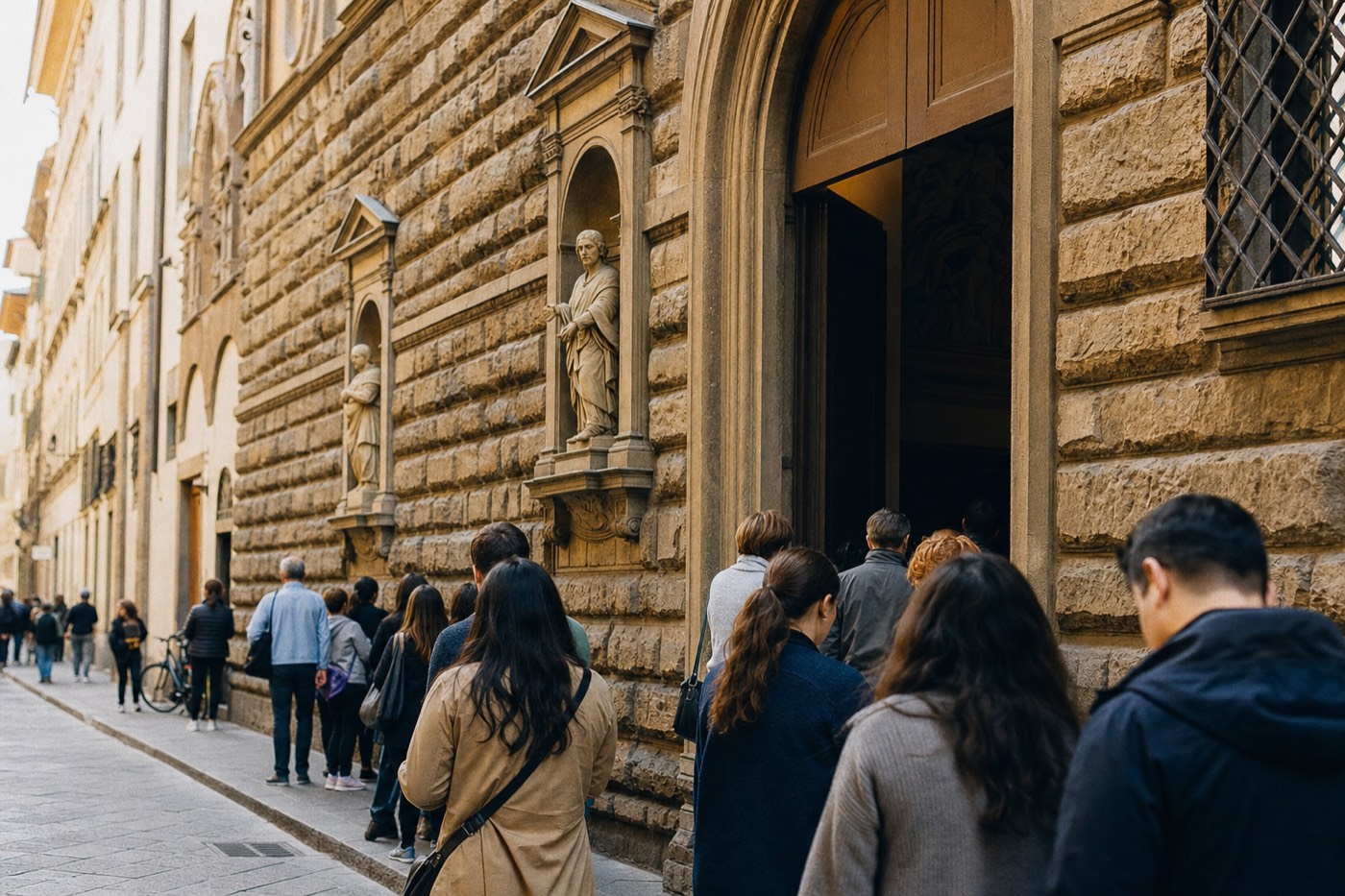
Almost everyone speeds up in the corridor. They have seen David at the far end, lit like a saint under his skylight, and their legs carry them past four rough blocks of marble without a second glance. I let them go. Then, on the way back, I stop the group in the middle of that corridor and ask them to look at the thing they just ignored: a man trying to climb out of the stone he is made of, and not quite making it.
What are the Prisoners in the Accademia?
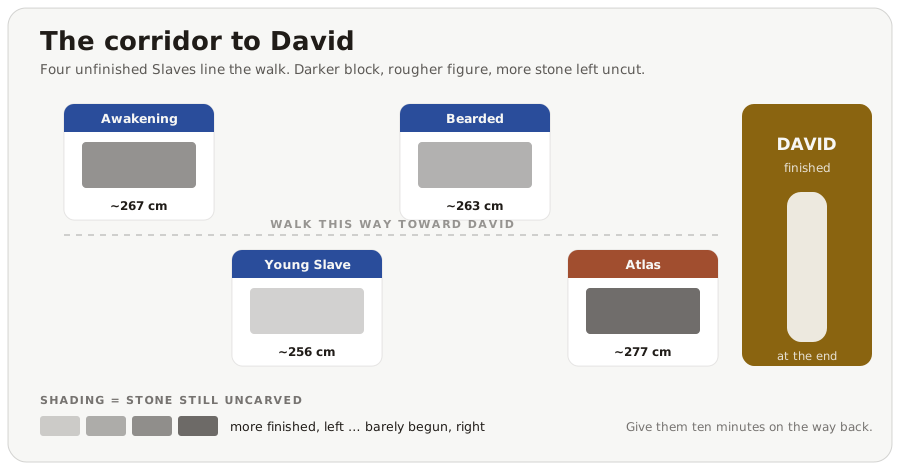
The Prisoners, also called the Slaves, are four unfinished marble figures by Michelangelo: the Awakening Slave, the Young Slave, the Bearded Slave and the Atlas. Carved in the 1520s and 1530s and reaching the Accademia in 1909, they line the corridor that leads to David, still half-buried in their blocks.
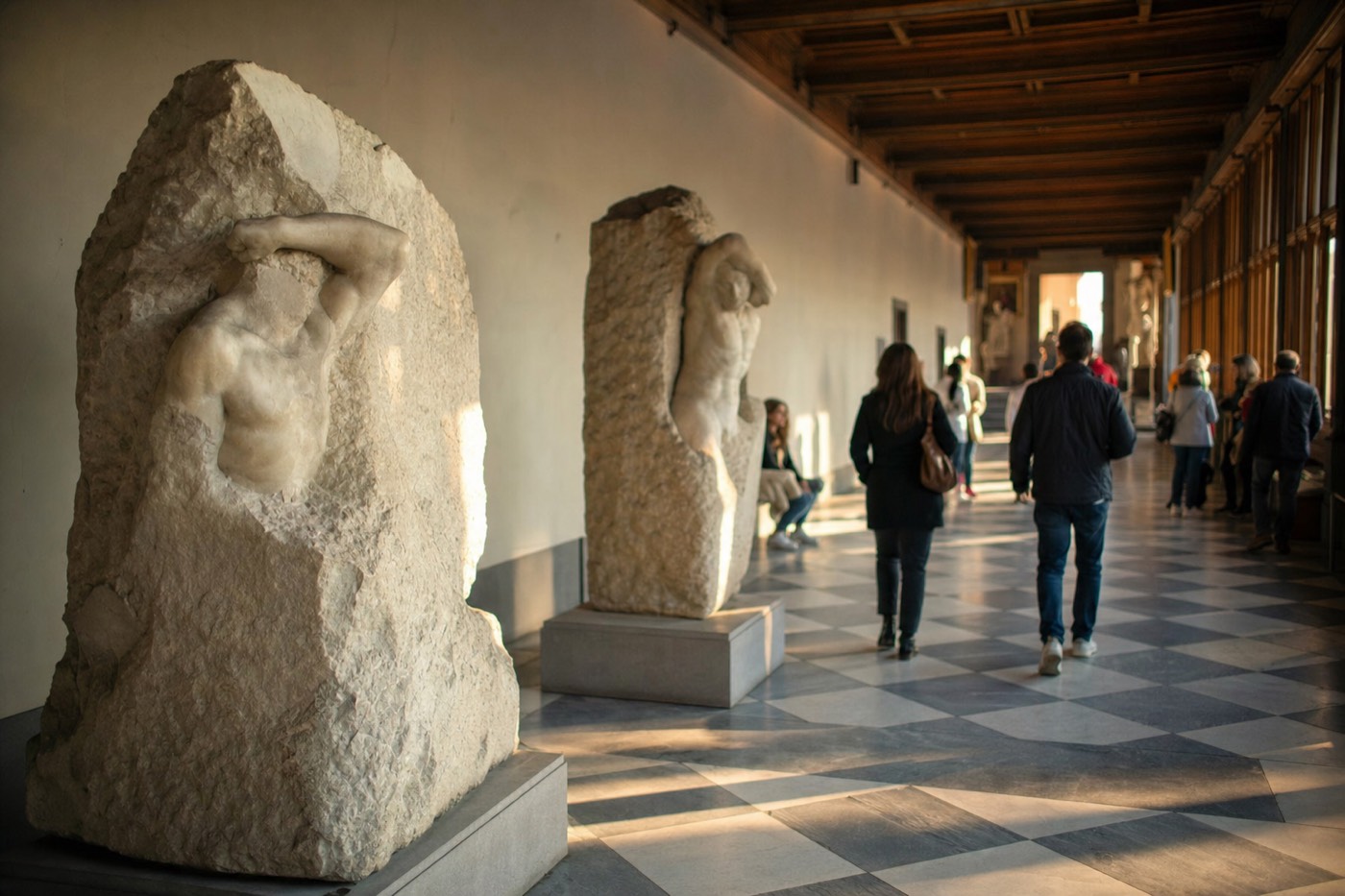
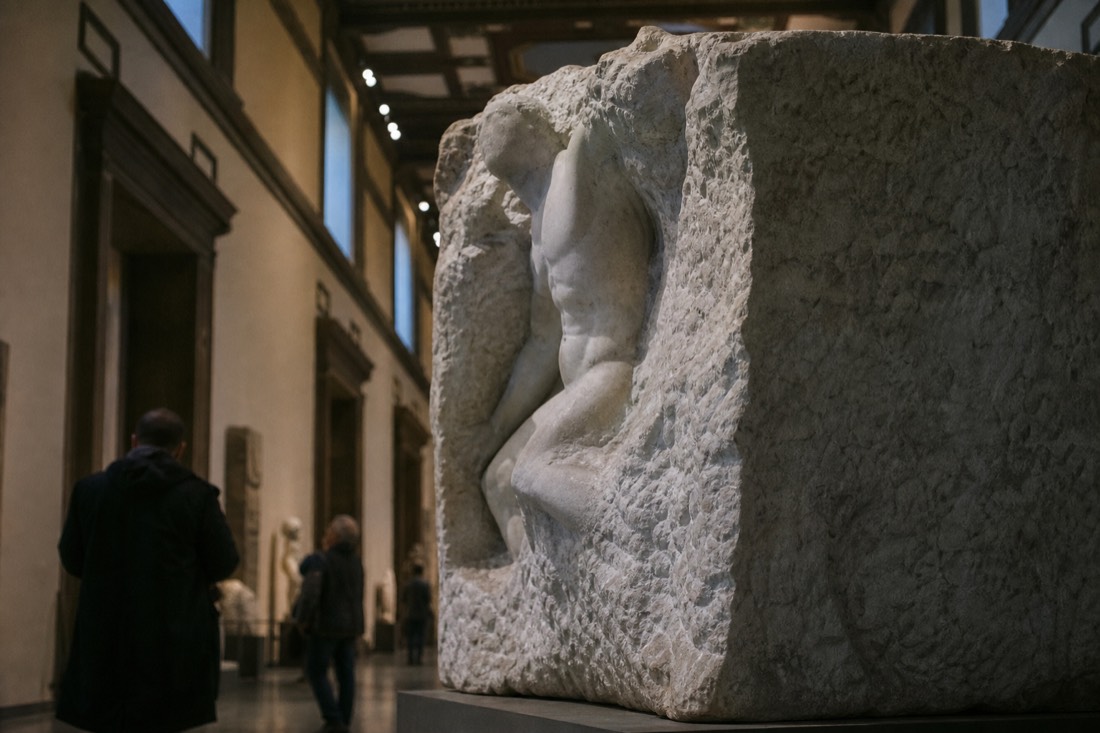
Each figure is a body straining against uncarved stone. An arm is free, a torso emerges, and then the marble simply reclaims the rest, a leg lost in the block, a face never released. They came to the gallery in 1909 after years in a grotto in the Boboli Gardens, and the museum's own history, summarized on Wikipedia's page for the Galleria dell'Accademia, traces the path that brought Michelangelo's marbles under one roof around his David.
| The four Prisoners | Approx. date | Height |
|---|---|---|
| Awakening Slave | c. 1520-23 | About 267 cm |
| Young Slave | c. 1530-34 | About 256 cm |
| Bearded Slave | c. 1530-34 | About 263 cm |
| Atlas Slave | c. 1530-34 | About 277 cm |
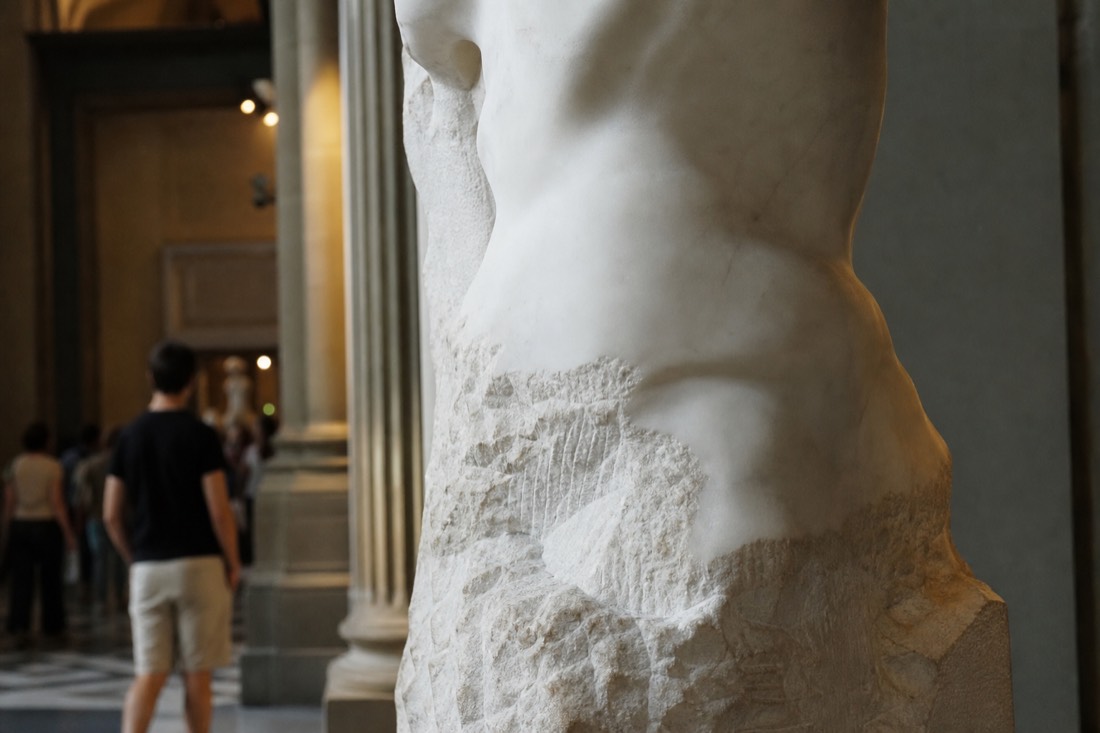
Notice the heights. Every one of them is taller than the man it depicts would have stood, because Michelangelo carved a margin of stone around the figure and then never cut it away. The Atlas is the extreme case, a head still trapped inside a squared block, hauling a weight that was never fully revealed. Stand close and you can read the chisel work, coarse claw marks on the rough zones, finer strokes where a shoulder is nearly done.
Were the Prisoners left unfinished on purpose?
Nobody can prove it either way, and that is the whole debate. The practical case says Michelangelo simply moved on when the commission collapsed. The aesthetic case, the non-finito reading, says the half-freed figures are the point, bodies caught in the act of struggling out of the raw block. Both readings live in the same corridor.
Here is where I slow a group down, because the honest answer is a shrug with evidence on both sides. On the practical side, these were work-for-hire figures for a tomb that kept shrinking, and a sculptor with a living to earn abandons dead projects. On the interpretive side, later viewers saw something deliberate: the human spirit fighting to break free of matter, the marble as a body's prison. That reading gave the works their nickname and their power.
| Reading | What it says | What supports it |
|---|---|---|
| Practical | Abandoned when the tomb was cut down | The commission collapsed after 1513 |
| Non-finito | Left rough on purpose, struggle as subject | Michelangelo's known interest in the figure "trapped" in stone |
| Middle view | Started conventionally, gained meaning later | The rough zones read as intentional to modern eyes |
Read the surfaces and the argument gets richer. On the finished zones you see the fine tooth of the flat chisel and the polish that follows it. On the rough zones the claw chisel, the toothed one, has dragged parallel furrows across the block, the marks a sculptor leaves while still hunting for the form. Michelangelo worked from the front face inward, freeing the figure the way you might coax a shape out of a bar of soap, which is why the Atlas still wears its block like armor across the shoulders and head. You are looking at a method, not just an abandonment.
I lean toward the middle view, and I say so as opinion, not fact. Whatever Michelangelo intended, the effect is undeniable once you stand there: these look more alive, straining and incomplete, than many finished statues do. The option I recommend runs at a variable provider price, Current reviews are shown on the provider page, and includes pickup two minutes from the door with free cancellation up to 24 hours. If you want a broader tour of everything in the building beyond the headline act, my full David guide sets the corridor in the context of the whole visit.
What were the Prisoners carved for?
They were carved for the tomb of Pope Julius II, the most cursed commission of Michelangelo's life. Planned as a vast free-standing monument crowded with figures, the tomb was cut down again and again after Julius died in 1513, with major revisions in 1516, 1521 and 1532. The Slaves fell out of the shrinking plan.
Michelangelo called the whole saga the tragedy of the tomb, and the phrase is not melodramatic. Julius commissioned a monument in 1505, then pulled him onto the Sistine ceiling instead. When the pope died in 1513, the family kept renegotiating downward. Every contract shrank the design, and figures meant to line a towering structure became surplus. The Prisoners are what a masterpiece looks like when the budget and the patron keep changing under it.
| Julius II tomb, the collapse | What happened |
|---|---|
| 1505 | Julius commissions a monumental tomb |
| 1513 | Julius dies; the family begins scaling the plan back |
| 1516 | A reduced contract is agreed |
| 1521 | The design shrinks again |
| 1532 | A further, smaller revision |
The final tomb, a fraction of the first dream, stands in Rome, not Florence, and it does not include these four. That accident of history is why they ended up here, orphaned figures gathered around the one statue that made Michelangelo untouchable. For where they sit in the room order, my walkthrough of what to see besides David maps the corridor stop by stop.
How should you actually see the Prisoners?
Walk toward David without stopping, let the corridor build the anticipation, and give David his time first. Then, on the way back out, spend a real ten minutes with the Prisoners. Reversed like this, the rough blocks read as process rather than warm-up, and you notice how much life sits in the unfinished stone.
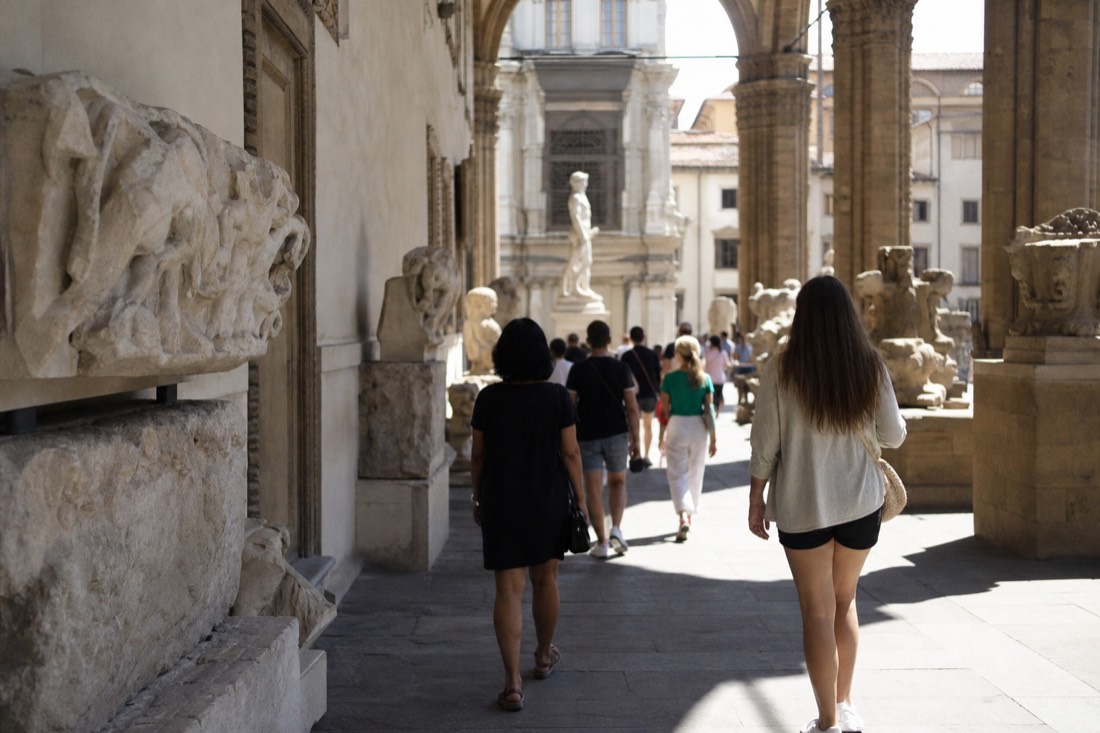
This is my one firm ritual in the building, and I stand by it. Most visitors treat the Prisoners as an appetizer and give them fifteen distracted seconds while craning toward David. Flip the order. Meet David when your eyes are fresh, then come back down the corridor and look at how he was made, the same chisels, the same hand, caught mid-decision. The Slaves teach you to read David's surface, which is why they belong at the end of the visit, not the start.
| The corridor, my way | Timing |
|---|---|
| Walk in toward David, no stopping | 1-2 minutes |
| Time with David in the Tribune | 15-20 minutes |
| Return walk, ten minutes with the Prisoners | 10 minutes |
| The Atlas alone, the least finished | 2-3 minutes |
To do any of this unhurried you want a timed entry, not a two-hour queue that leaves you rushing. Current hours and prices sit on the official visit page, and if you want the room-by-room path, the Accademia map and route lays it out. If you are still deciding which museum to give your one free morning, my Uffizi versus Accademia comparison settles it honestly.
Give the Prisoners their ten minutes. They are the only place in the world where you can watch Michelangelo think, the decisions still open, the stone still arguing back.
Your Next Step
Check Your Florence Date
Private Accademia Art Tour
Have your travel date in mind? Discuss David and the unfinished sculptures with your own art historian guide. Check the start and meeting details before arranging your next stop.
2 hours; admission included. Selected central hotels offer walking pickup, not a car transfer. Confirm your exact hotel or meeting point with the operator.
Initial editorial suggestion. Confirm the option, party requirements and final total before paying.
Scheduled departures load automatically. Final availability and price are confirmed on Viator.
A scheduled start is not a confirmed place. Your date is a planning aid; select it again on Viator.
No verified option fits those choices. Adjust the controls or reset to the general suggestions.
Compare Options And Fit This To Your Visit
Private Accademia Art Tour: Discuss David and the unfinished sculptures with your own art historian guide. 2 hours; admission included. Selected central hotels offer walking pickup, not a car transfer. Confirm your exact hotel or meeting point with the operator.
Accademia Timed Entry: Explore David, the Prisoners and the other permanent rooms at your own pace. 60 minutes suggested; allow extra time for security. Meet at Via Ricasoli 45 blue, 15 minutes early; bring matching ID for every visitor. No live guide or luggage storage.
Accademia With An English Guide: See David with an English-speaking guide, then stay inside to explore independently. 65 minutes; admission and headsets included. Meet at Via Ricasoli 39, 15 minutes early. No hotel pickup, meals or luggage storage.
Accademia Entry And Audio Options: Choose an independent visit with a phone audio guide, or select a licensed guided option. About 1 hour. Permanent exhibitions included. Audio and guided inclusions depend on the option selected. Bring ID, a charged phone and headphones; arrive 10–15 minutes early at the option’s meeting point. Large bags prohibited.
Affiliate links may earn us a commission at no extra cost to you. Booking is completed with the provider.